
The Effortless Ballet Strength Training Guide: The Ballet Warm Up and Workout Routine Every Mom Needs
If you’ve ever watched a ballet dancer move across a stage and thought, how does


Nobody warns you about this part: a few weeks after birth, your skin joins the postpartum party. Breakouts like you’re sixteen again, dryness like the Sahara, melasma patches, and a face that reacts to products you’ve used for years. Postpartum skin care isn’t vanity – it’s understanding what your hormones are doing and responding with gentleness instead of an arsenal of harsh products.
During pregnancy, high estrogen gave many of us that famous glow. After delivery, estrogen falls off a cliff, and your skin feels it:
Add sleep deprivation and dehydration (hello, breastfeeding thirst) and your skin is working hard. The answer is fewer, gentler, purer products — especially while nursing, when what goes on your skin matters more than ever.
Your skin absorbs a meaningful share of what you put on it, and some common actives – retinoids, high-dose salicylic acid, hydroquinone – are on the avoid list while breastfeeding. The simplest safety filter: if the ingredient list needs a translator, skip it. Short, natural ingredient lists aren’t just a preference in the fourth trimester; they’re the safest choice.
Two minutes, twice a day. That’s all this takes – which matters, because you don’t have more than that.
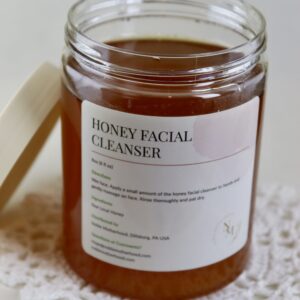
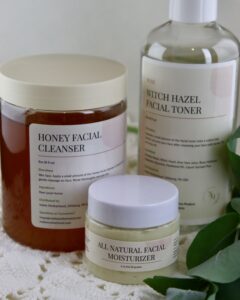
Raw honey is naturally antibacterial (helps postpartum breakouts), gently exfoliating, and completely nursing-safe — it cleanses without stripping your already-fragile skin barrier. Here’s the full method in our guide to washing your face with honey, and our Honey Facial Cleanser comes from local Georgia beekeepers.
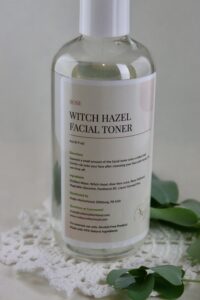
Witch hazel calms redness, gently tightens pores, and rebalances your skin’s pH after cleansing — as long as it’s alcohol-free (alcohol-distilled versions will torch sensitive postpartum skin). Rose water adds hydration and makes the whole step feel like a tiny spa moment. That combination is exactly our Rose Witch Hazel Facial Toner, and here’s why witch hazel works for every skin type.
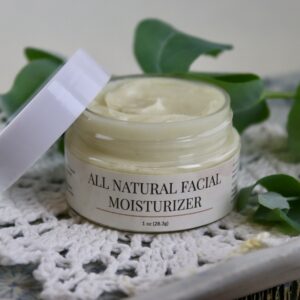
Seal in hydration with a simple, plant-based moisturizer applied while your skin is still damp from toner. No parabens, no synthetic fragrance – both matter double when your skin barrier is compromised and a baby spends hours nuzzled against your cheek. Here’s what to look for in the best all natural face moisturizer, or go straight to ours.
Here’s the real reason we love a simple skincare routine in the fourth trimester: it’s two minutes that belong entirely to you. In a season where your body feeds, holds, and soothes someone else around the clock, washing your own face with warm honey water is a tiny, daily act of stewardship. It’s the same philosophy behind our postpartum care package ideas — mama’s care counts too. If you want all three steps in one box, that’s the Facial Care Bundle.
Q: Why is my skin so bad postpartum?
A: The steep drop in estrogen after delivery triggers oil swings, dryness, and sensitivity — compounded by sleep deprivation and breastfeeding dehydration. It’s hormonal and it’s temporary.
Q: What skincare ingredients should I avoid while breastfeeding?
A: Retinoids (retinol, tretinoin), hydroquinone, and high-dose salicylic acid. Stick to short, natural ingredient lists and ask your provider about anything you’re unsure of.
Q: How long does postpartum skin last?
A: Most changes settle as hormones rebalance over 6–12 months. Melasma can take longer — daily mineral SPF is the biggest accelerator.
If you’ve ever watched a ballet dancer move across a stage and thought, how does

We spend nine months preparing for birth — the classes, the bag, the birth plan

If you’ve ever flipped a store-bought moisturizer jar around and squinted at an ingredient list